PSL RatingsGet Rating

PSL score ranges

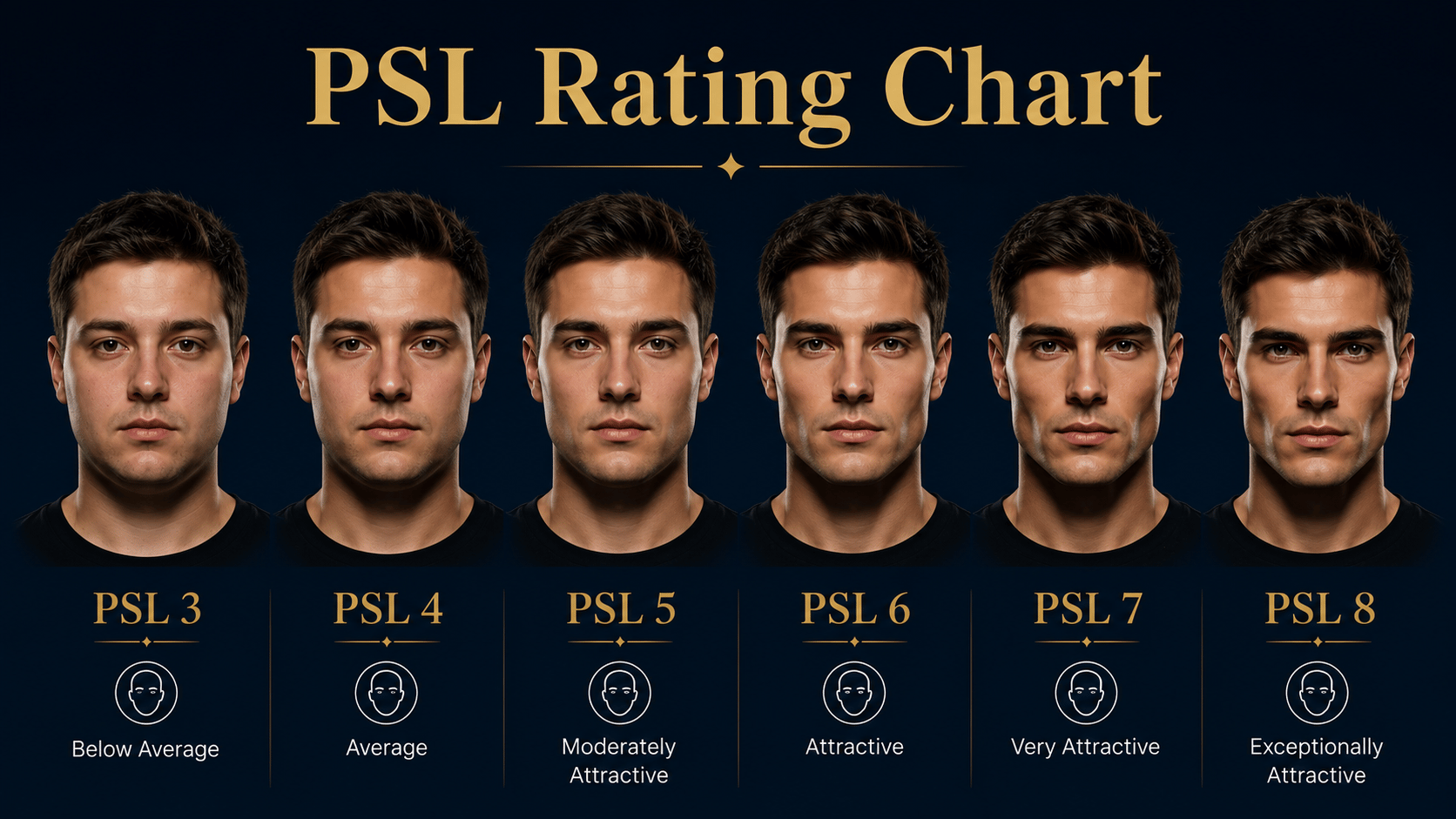
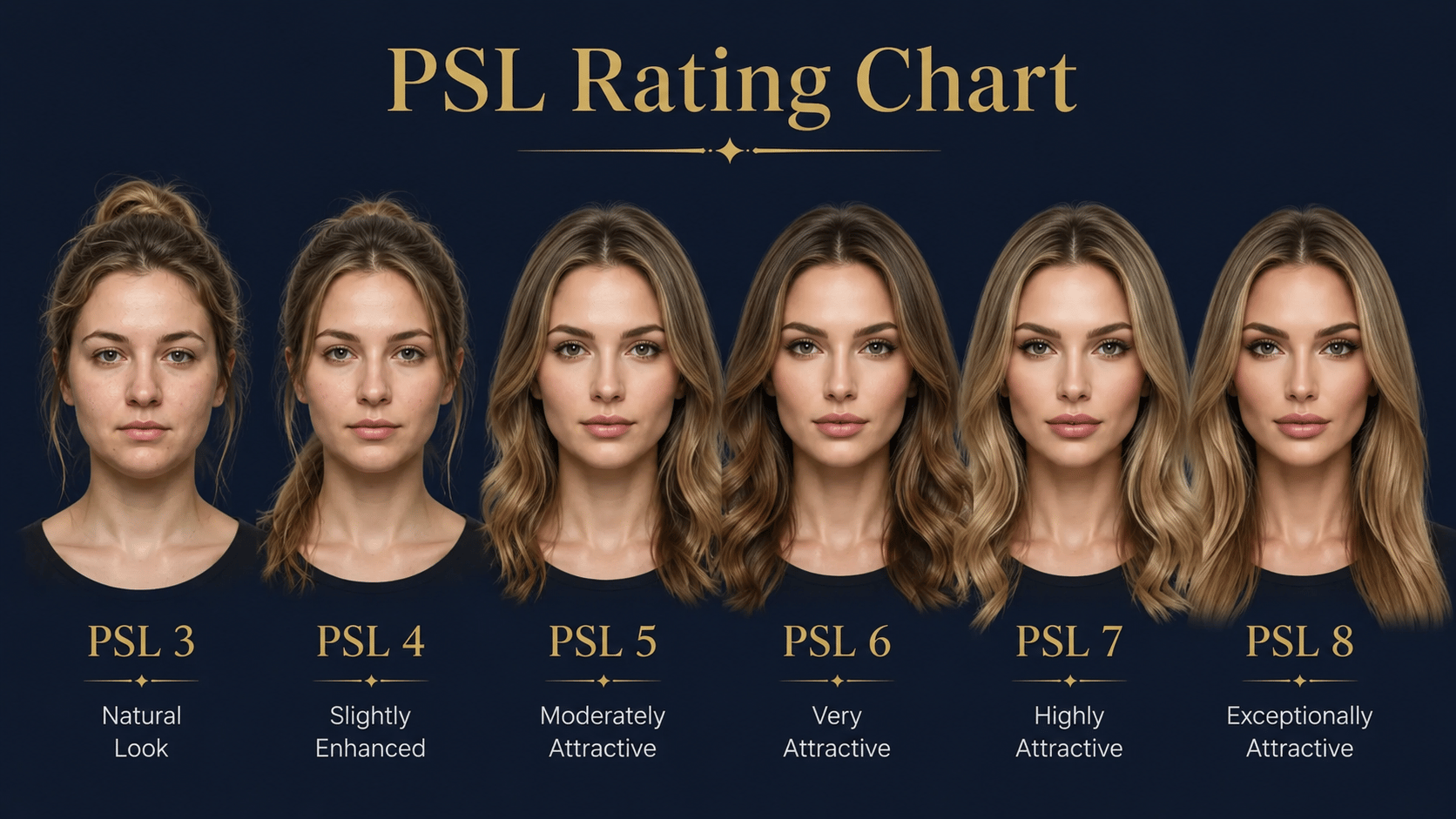
PSL Rating Chart

Use this chart to understand broad PSL score ranges. It explains what each tier usually means without treating a number as personal worth or permanent identity.

Get your own PSL rating

Visual examples

PSL Rating Chart Examples

These reference images are shown large so the score labels and visual differences are readable. Open the original image if you want to inspect the chart at full resolution.

Large PSL rating chart example for men showing score ranges from PSL 3 through PSL 8
PSL rating chart example for men.Open full-size image
Large PSL rating chart example for women showing score ranges from PSL 3 through PSL 8
PSL rating chart example for women.Open full-size image

How to read it

How to Read the PSL Rating Chart

A PSL rating chart is best read as a set of score bands, not as a personality test or a permanent label. The chart describes how a face is likely to be interpreted from visible photo evidence: harmony, proportions, structure, angularity, dimorphism, skin clarity, grooming, lighting, and pose. The bands are intentionally broad because one photo cannot capture every angle or every real-world impression.

The biggest mistake is reading the chart like a casual 1-10 attractiveness poll where every point is evenly spaced. PSL-style ratings are usually stricter and more compressed. The middle ranges contain many normal faces, while very high scores should be rare. A move from 4 to 5 is not the same as a move from 7 to 8. Higher tiers require more category consistency and fewer visible weak points.

Use the chart together with photo quality. A front-facing image in natural light gives the clearest evidence. A blurry, tilted, filtered, or highly stylized photo can exaggerate strengths or weaknesses. If your result surprises you, compare several clean photos before deciding the tier is stable.

Score table

What Each PSL Score Means

The table gives a fast overview of the ranges. The longer tier notes below explain how common misreads, proportions, and photo conditions affect each band.

Score
Tier
Common read
Notes
1-2
Very low
Severe disharmony or very poor photo conditions.
Use careful wording here. A single weak photo can exaggerate the result.
3
Below average
Several visible imbalances or presentation issues.
Lighting, blur, angle, and grooming can move this range more than users expect.
4
Average / low-average
A normal face read with weaker harmony, structure, or presentation.
Most people cluster near the middle, so decimal precision should not be overread.
5
Above average
Balanced face, decent harmony, and a stronger first impression.
Good photo discipline and grooming can matter, but structure still anchors the score.
6
Attractive
Stronger structure, proportions, and category balance than the typical range.
Usually requires more than one strong feature; the full face has to read well together.
7
Very attractive
Strong harmony, standout structure, and few visible weak points.
Rare in ordinary photo samples and sensitive to photo evidence quality.
8+
Elite
Exceptional structure, presentation, and facial balance.
Treat this as a broad elite tier, not a promise that one image can prove an exact rank.

Tier notes

PSL Rating Tiers Explained

Each tier below is written as a practical interpretation guide. The descriptions are not medical, scientific, or identity labels. They explain how a strict PSL chart is usually read from photos.

PSL 1-2

PSL 1-2 is the lowest band on a strict PSL rating chart, but it should be read with more caution than most people give it. In real use, this range is uncommon when the photo is clear and the face is visible. It usually means the image shows severe disharmony, extreme asymmetry, very weak structure, or photo conditions so poor that the rating has little confidence. A common mistake is treating a 1-2 score as a permanent identity label. It is better to read it as a signal that the current evidence is weak or that multiple visible categories are pulling down the estimate at the same time.

Photos can distort this tier more than users expect. Strong side angles, harsh flash, motion blur, wide-angle lenses, facial obstruction, or a tense expression can make normal proportions look much worse. If a tool returns a 1-2 from a low-quality selfie, the next step is not to panic. Retest with a neutral, front-facing image in natural light, then compare whether the low score repeats across more than one clean photo.

PSL 3

PSL 3 is usually read as below average in a strict chart. It does not mean every feature is weak. More often, it means several visible factors are working against the overall read: weaker facial balance, a recessed or unclear lower third, visible asymmetry, poor skin or grooming presentation, or an angle that hides structure. This tier can be over-assigned by harsh tools because a face with one weak category may be dragged down even when other categories are usable.

The most common misunderstanding is assuming PSL 3 is purely structural. In practice, photo evidence matters a lot here. Bad lighting can flatten cheekbones, a low camera can distort the jaw, and a close lens can widen the center of the face. People in this range often see the largest change between a casual selfie and a controlled front-facing photo. That does not mean the chart is fake; it means the chart is sensitive to visible evidence.

PSL 4

PSL 4 is the normal middle band for many chart interpretations. It usually describes a face that reads average or low-average: enough balance to look ordinary, but not enough standout harmony, angularity, or presentation to move clearly above the middle. Because this is a broad range, a 4.1 and a 4.8 can feel different in real life even though both sit inside the same tier. This is also the range where decimal precision should be treated lightly.

A common mistake is reading PSL 4 as a bad result. It is more accurate to see it as the chart's central zone. Many faces land here because one or two categories are normal while another category is less favorable. Photo quality can move this tier in both directions. A clean photo with balanced lighting may reveal better structure, while an awkward pose may make a mid-range face look lower. The right question is which category is limiting the result, not whether the number is flattering.

PSL 5

PSL 5 is typically above average. The face reads balanced enough that the viewer notices attractive traits rather than only neutral traits. This does not require perfection; it can come from strong harmony, a clean lower third, good eye area, clear skin, or a polished presentation that supports the structure already there. In a strict PSL rating chart, this range is meaningful because it is above the common middle without claiming model-tier rarity.

The biggest misunderstanding is mapping PSL 5 directly to a casual 5 out of 10. That is not how the chart works. On many PSL-style scales, a 5 can already read good-looking in everyday terms. Photo impact is still real, though. A strong social photo can push presentation higher, while a flat passport-like image may reduce perceived angularity. The best reading is that PSL 5 shows several positive signals, but not enough category dominance to call the face rare.

PSL 6

PSL 6 is the attractive tier in a strict chart. The face usually has multiple categories working together: better harmony, clearer proportions, stronger lower-third definition, and presentation that does not hide the structure. A true 6 is not just one impressive feature. It is the combination of features that makes the face read cohesive. This is why the jump from 5 to 6 feels larger than a casual one-point move on a 1-10 scale.

Users often misread this tier by overvaluing one feature, such as a good jawline or good eyes. A single strong feature can help, but weak harmony or poor presentation can still hold the overall score below 6. Photo influence also changes at this level. A clean photo can confirm the tier, but a flattering angle can also temporarily imitate it. If several neutral photos keep landing in the same range, the rating is more credible than one highly curated image.

PSL 7

PSL 7 is very attractive and should be rare in a serious chart. The face typically shows strong overall harmony, clear structure, good category balance, and few obvious weak points. At this tier, the chart is no longer describing normal above-average presentation. It is describing a face that stands out even when the photo is not doing all the work. The score is less about one detail and more about the full face holding together across dimensions.

The common mistake is using PSL 7 as a compliment rather than a strict tier. Many people call a good photo a 7 because the styling, lighting, or expression is strong. A stricter read asks whether the underlying face still appears very strong in ordinary conditions. Photos matter, but they matter differently here. Bad photos can lower confidence, yet a true 7 should not depend entirely on one ideal angle. Repeated evidence across multiple images matters more than one polished result.

PSL 8+

PSL 8+ is the elite end of the chart. It should be treated as an exceptional range rather than a normal high score. In practical terms, it means the face appears extremely strong across harmony, structure, dimorphism, angularity, and presentation at the same time. There are few visible weak points, and the overall read is memorable without relying only on styling. This band is useful as a ceiling concept, but exact decimal claims inside it are often overconfident.

The biggest misunderstanding is assuming an 8+ can be proven from one photo. A single image can show a strong impression, but it cannot fully prove consistency across angles, expressions, lighting, and camera distances. This tier should be rare enough that most tools should hesitate before assigning it. If a photo receives 8+ because of heavy editing, unusual lighting, or a highly curated pose, the chart is being used too loosely. Treat it as a repeated-evidence tier.

Interpretation

What Moves a Rating Up or Down

The chart is shaped by several categories at once. A score changes most when multiple categories support the same direction rather than when one isolated feature looks good in one photo.

Harmony usually moves the whole chart reading first

Harmony is the reason a face can score higher than the sum of its individual features. When the eye area, midface, nose, mouth, jaw, and facial thirds feel balanced, the chart reading becomes more stable. When one area dominates or interrupts the rest, even strong isolated features may not raise the overall tier. This is why a tool should not simply reward the sharpest jawline or the best skin. The strongest ratings usually come from categories working together.

Structure and angularity create visible tier separation

Structure matters because it changes how the face holds up under ordinary lighting. Jawline visibility, chin balance, cheekbone support, and lower-third definition can move a rating upward when they are clear and proportional. The opposite is also true: weak visible structure can keep a face in the middle range even when skin, hair, or expression are good. Camera angle can exaggerate this category, so a strict chart should reward structure that remains visible across normal photos.

Presentation changes the estimate, but it should not replace structure

Presentation includes grooming, skin clarity, lighting, sharpness, expression, and the general quality of the photo. It can move a score, especially around the middle tiers, because people judge what they can see. However, presentation should not be treated as the whole rating. A polished photo can make a result more favorable, while a harsh photo can hide strengths. The best use of the chart is to separate presentation problems from deeper category limits.

The top tiers have diminishing returns

Moving from 3 to 4 or 4 to 5 can happen through clearer evidence and better presentation. Moving from 6 to 7 is much harder because the chart starts asking for fewer weak points and stronger category consistency. At the high end, each extra point represents a larger jump than it seems. That non-linear shape is one reason many PSL-style scales stop around 8 instead of behaving like a casual 1-10 attractiveness poll.

Photo limits

Why Photos Can Change Results

A PSL chart describes score bands, but the input photo controls how much evidence the tool can see. Front-facing, naturally lit photos reduce noise.

Strong side angle
Harsh overhead lighting
Heavy filters
Blur or low resolution
Face partly covered
Wide-angle distortion

Free test

Want to map your own score to the chart?

Run the free PSL rating test, then use this chart to interpret the score as a range.

Start free rating

FAQ

PSL Rating Chart FAQ

Is the PSL rating chart a scientific scale?

No. It is an internet scoring convention for discussing perceived facial attractiveness. Use it as a broad guide, not a scientific diagnosis.

Why do photos change PSL ratings?

Angle, lighting, lens distortion, expression, grooming, and image sharpness can all change how facial structure is perceived.

What score range is most common?

Most people cluster around the middle ranges. Very high and very low scores should be less common when the rating is strict.

Should I compare my score to celebrities?

Celebrity comparisons are usually misleading because professional lighting, styling, editing, and selection bias change the visual evidence.